
Bettor wants to sign up for an online sportsbook

The path from "I want to bet on the game tonight" to an actual wager placed runs through a fixed sequence of checks, and skipping ahead isn't possible no matter how fast the signup form looks. Every legitimate operator runs the same gates in the same order before a dollar changes hands.
- State legality check. The app or site first confirms online sports betting is authorized where the bettor is physically located — not where they live, where they are right now. States that haven't passed enabling legislation simply won't show licensed operators in app store listings or will block registration outright.
- Geolocation verification. Once legality is established in principle, the app pings the device's location services to confirm the bettor is inside state lines at the moment of registration and at the moment of every bet. This is why a bet placed from a car in the parking lot of a stadium just across a state border gets rejected even though the bettor's home address is fine.
- Registration and KYC. Name, date of birth, Social Security number (or last four digits), and address get submitted and checked against identity databases to confirm the bettor is of legal age and who they claim to be. This step exists because regulators require it, not because the operator is curious.
- Deposit and welcome offer. Only after identity clears does a deposit method unlock — bank transfer, debit card, PayPal, or similar — and the first-deposit promotion typically applies automatically or via a promo code entered at this stage.
A bettor who gets stuck usually gets stuck at step 1 or 2: the app thinks they're somewhere they aren't, or their state hasn't legalized the product yet. Neither is a bug to troubleshoot around — both are the system working as designed.
Two sportsbooks advertise similar bonus headlines
The sportsbook with the bigger number in its ad isn't automatically the better account, and comparing headline bonuses side by side without reading the mechanism behind them is the single most common mistake a new bettor makes. Three things determine what a bonus is actually worth, and none of them is the number in the ad.
| What to check | Why it matters |
|---|---|
| Rollover / playthrough multiple | A $200 bonus with a 5x rollover on odds of -150 or worse requires roughly $1,000 in qualifying handle before it's realizable — often more than the bettor would have wagered anyway |
| Cash vs. bonus bets | Winnings from a cash deposit are withdrawable; winnings generated from a bonus bet are frequently credited as more bonus bets, not cash, until a final conversion step |
| Expiry window | A bonus that expires in 7 days forces faster, often worse-value betting just to use it up before it disappears |
A bettor comparing two offers should read the terms page, find the rollover multiplier and the game or bet-type contribution rates, and run the arithmetic before signing up for whichever number looks bigger. The headline figure is marketing; the rollover clause is the actual offer.
Bettor mainly plays player props and live in-game markets
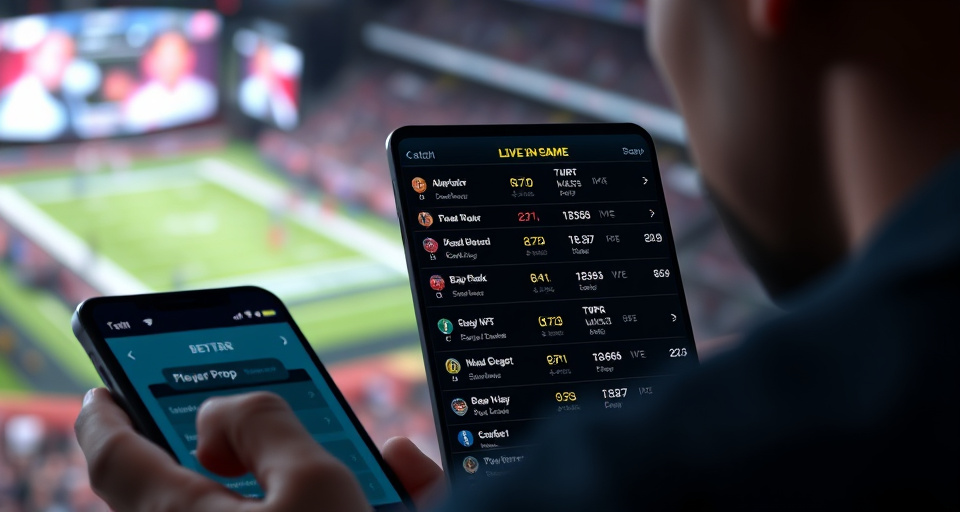
A bettor whose action is mostly player props and in-play lines should weight an app's market depth and technical speed over its promotional size, because those are the two things that actually determine whether the bets they want to place are even available and priced fairly in the moment. Prop and live markets move fast, get suspended during scoring plays, and often get re-priced within seconds — a slow app isn't just an annoyance here, it's a direct cost.
The two failure modes specific to this bet type:
- Market suspension during live play means a bettor who finds a number they like can watch it vanish before the bet confirms, especially on apps with slower backend settlement.
- Thin prop menus on some operators mean a bettor who wants a specific player's receiving yards market simply won't find it offered, forcing a worse substitute bet or no bet at all.
For this bettor, the decision rule is: pick the app with the deepest menu in the specific sport and bet type played most, and treat uptime and bet-slip speed as a selection criterion on par with odds — not a secondary comfort feature.
Search results surface a site that accepts users from a non-legal state
A site willing to take a deposit from a bettor in a state where online sports betting isn't authorized is not a sportsbook operating under a technicality — it's an offshore book operating outside any US regulator's reach, and the practical consequences are real. Without a state license, there's no regulator-mandated self-exclusion program, no deposit limit tool, no dispute process if a withdrawal is delayed or denied, and no state consumer-protection fund behind the money sitting in the account.
Colorado's gaming regulations, for example, spell out the licensing, advertising, and consumer-protection obligations a sportsbook operating in that state must meet — requirements that simply don't apply to an operator with no license in the first place. That's the practical test: a licensed operator can point to a specific state license number and a regulator a bettor can contact; an offshore site can only point to its own terms and conditions, which it wrote and can change unilaterally.
Before depositing anywhere unfamiliar, a bettor should confirm licensing directly with the relevant state gaming authority rather than taking the operator's own "licensed and regulated" claim at face value — the claim costs nothing to make and offshore books make it routinely.
Can a bettor realistically make $100 a day sports betting?
No — not as a fixed, repeatable daily target, and understanding why requires looking at the math rather than the marketing. A sportsbook builds a margin, commonly called the vig or hold, into the odds on both sides of a market; on a standard -110/-110 point spread, a bettor needs to win roughly 52.4% of bets just to break even, before any daily profit target enters the picture.
A fixed $100-a-day goal assumes a level of consistency that doesn't exist in a product built around variance. Some days a well-handicapped slate returns $300, some days it returns negative $400, and forcing the number to land on exactly $100 means either stopping while ahead at an arbitrary point or chasing losses to get there — both of which erode the long-run edge a disciplined bettor might otherwise have. Research framing sports betting as an emerging behavioral pattern worth studying in its own right has flagged exactly this kind of fixed-target, loss-chasing behavior as a marker worth monitoring rather than a viable strategy to plan around, since it tends to override the underlying math rather than improve it, according to recent behavioral research on sports betting.
What's realistic instead is a staking plan sized to a bankroll — commonly 1-2% of total bankroll per wager — with a long-run expected value calculated from the bettor's actual hit rate against the market's vig, not a flat daily dollar figure. A bettor with a demonstrated edge and a large enough bankroll might average toward a given weekly or monthly return over hundreds of bets; no legitimate approach produces $100 reliably every single day.
Sports betting app
For most bettors, the sportsbook is the app, not a desktop site — registration, geolocation, bet placement, and withdrawal requests all happen through the same mobile client, and the app's technical performance is effectively the product. The things that distinguish one app from another in daily use are bet-slip speed, how quickly live odds update, how clearly rollover terms are surfaced before a deposit, and how the withdrawal request flow is built, since a confusing cash-out screen is a common source of support complaints that have nothing to do with the odds themselves.
A bettor choosing between apps should treat a short trial period — placing small bets across a few sessions — as part of due diligence before moving meaningful money onto any one platform, since odds pricing and bonus terms are easy to compare on paper but app stability only shows up with actual use.
DraftKings
DraftKings is one of the two sportsbook brands most bettors will encounter first, by virtue of market share and advertising reach in the states where it's licensed. Its bet-type coverage spans the standard spread, moneyline, and total markets along with player props and live betting, and like every US-licensed operator it only registers accounts in states where it holds an active license and where geolocation confirms the bettor is physically present.
Evaluating DraftKings against any alternative comes down to the same decision rule as any other operator comparison: check the actual odds priced on the markets the bettor plays most, read the welcome offer's rollover terms in full rather than the headline number, and confirm the state license directly with the relevant regulator rather than assuming brand recognition substitutes for licensing status.
FanDuel
FanDuel is the other sportsbook brand nearly every bettor runs into, and it follows the identical registration, geolocation, and KYC sequence as any other licensed operator — brand size doesn't exempt an account from identity verification or state-line enforcement. A bettor asking what happens after a large win, such as a six-figure payout, is really asking about the operator's reporting obligations: licensed US sportsbooks are required to issue tax reporting forms on sufficiently large payouts and may structure withdrawals above certain thresholds differently than a routine cash-out, which is a tax and compliance matter rather than a sign anything went wrong with the account.
As with DraftKings, the right comparison isn't "which app is better" in the abstract — it's which app prices the specific markets a bettor plays most competitively, and which one's bonus terms actually convert to cash in a reasonable window.
State legality and licensing
Online sports betting legality is decided state by state, and the legal status in one state says nothing about the status next door — a bettor who assumes national uniformity is the one most likely to get a surprise geolocation block. Some states have passed legislation authorizing licensed online sportsbooks and have active regulators overseeing them; others permit only retail sportsbooks at tribal or commercial casinos; and others haven't authorized sports betting in any online form, meaning every app simply geoblocks registration from within those borders.
California is a clear example of a large state where online sports betting remains unauthorized despite repeated ballot and legislative attempts, meaning licensed national sportsbook apps don't operate there even though they're active in many neighboring states, according to a rundown of California's current sports betting status. That gap — a major population center with no legal online market — is exactly the kind of mismatch that drives bettors toward unlicensed offshore sites, which is precisely the scenario worth avoiding rather than working around.
Broader context on how the legal online market scaled after the 2018 federal repeal of the sports betting ban shows the pace at which states have added licensed operators since then, with the number of legal online markets expanding considerably in the years following, per reporting on how online and sports betting changed after 2018 and through the pandemic. The practical lesson for a bettor isn't the history — it's that the list of legal states keeps changing, so checking current status at signup matters more than remembering what was true a year or two ago.
Confirming a state's status and an operator's license directly with the relevant state gaming authority — not with the operator's own marketing page — remains the one verification step every bettor should do before the first deposit, regardless of which brand or app they've chosen.